For Quality
Designed to support 21 CFR Part 11. Your quality team stays in control.
enCompass360° is batch review software for manufacturing. It reads your historian, alarms and batch databases, puts one batch on one screen (on the reference deployment, batch investigations went from weeks to minutes), and leaves every source's records and audit trails as they are. Your SOPs, your release decision and your change control stay yours. Validation support comes through Innovative Consulting, our sister company, and a standard validation package for enCompass360° is in development.
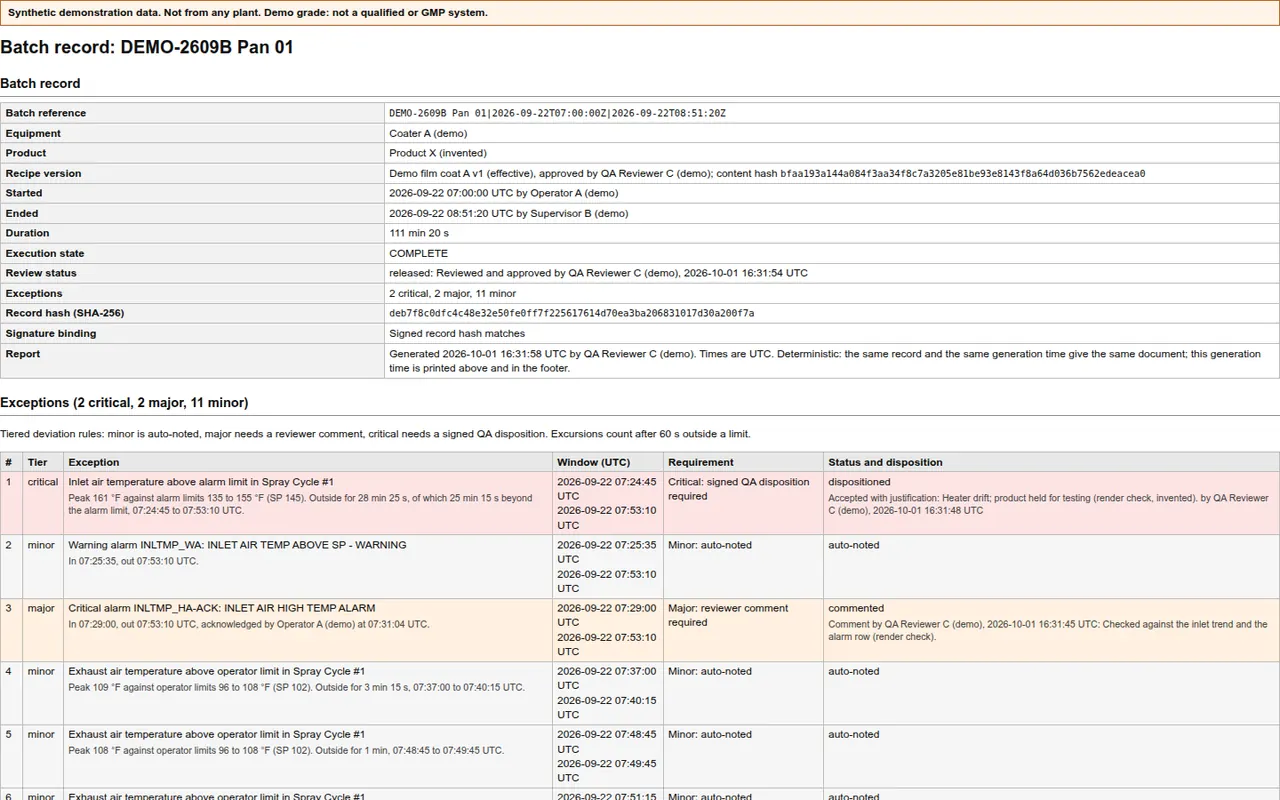
Part 11 controls, and where each one stands.
One line on how the design addresses each requirement, and whether it is in the installed product today or shown in the live demo.
| Requirement | How the design addresses it | Status |
|---|---|---|
| Audit trail | Each source system keeps its own records and its own audit trail. The review layer reads them in place and shows the audit trail beside the batch. In the live demo, every audit row is hash-chained to the row before it and a Verify check detects an edited, deleted or inserted row. | In production Hash chain in the live demo |
| Electronic signatures | In the live demo, the batch report signature is bound to a hash of the record, critical exceptions need a signed QA disposition, and a recipe is approved by a different person with an e-signature. How a signature shows the signer, the date and time and its meaning (21 CFR 11.50) is answered in writing for your supplier assessment. | In the live demo |
| Review by exception | In the live demo, exceptions are tiered: minor ones are noted, major ones need a reviewer comment, critical ones need a signed disposition. Release stays blocked until every requirement is met. The person who ran or verified a batch cannot release it. | In the live demo |
| Source records | The review layer reads every source in place and writes nothing back. Nothing in the source systems is changed. | In production |
| Copies of records | Reports as HTML and PDF, assembled the same way every time. | In production |
| Access and sign-in | Who can see, sign and release what is set by role in the live demo. How sign-in works at your site is covered in the deployment conversation. | In the live demo |
Who owns what.
Records the review itself creates, such as a signed report or a review comment, are agreed in the deployment conversation: where they are kept, for how long, and whether they are your GMP record of review or an aid to it. The recipe module, if you deploy it, is separate from the batch review, and how approved recipes reach the line goes through your change control.
Whether a connection touches the validated state of the historian or the MES is your change-control call. We supply the connection description and the read-only evidence that goes into it.
Yours
- Your SOPs and your review procedure
- The release decision and every disposition
- Change control, including the validated state of your source systems
- The records in your historian, batch and control systems
What enCompass360° does
- Reads each source in place, without changing it
- Lines every record up on one time axis for the batch
- Shows the batch, its exceptions and the comparison to other batches
- Produces the report as HTML and PDF
"The investigation shall extend to other batches of the same drug product and other drug products that may have been associated with the specific failure or discrepancy."
21 CFR 211.192Batch-to-batch comparison is how an investigator answers that sentence with evidence instead of memory. enCompass360° puts those other batches on the same axis, every parameter, every alarm and every operator action, so you can see whether the same pattern appears in them. The 21 CFR 211 section each data source relates to is listed on the product page.
ALCOA+, in plant terms.
Regulators judge records against ALCOA+ (FDA 2018, MHRA 2018, PIC/S PI 041). A record assembled by hand from six systems can meet it, at the cost of the weeks, and every transcription is a point an inspector can test. The full argument is on Why data matters. Below, where each principle sits in enCompass360°, and where your own validated process carries it.
- AAttributableWho did it, and when.In enCompass360°: Each source keeps its own audit trail with its users and times. The review layer reads it in place and shows it beside the batch.
- LLegibleReadable and permanent.In enCompass360°: Reports as HTML and PDF, assembled the same way every time.
- CContemporaneousRecorded as it happens.In enCompass360°: Every reading is placed on one time axis for the batch, at the time its source recorded it.
- OOriginalThe first capture, with its lineage.In enCompass360°: Read where it sits. The review layer writes nothing back, so the first capture stays in the system that made it.
- AAccurateNo unauthorized change.In enCompass360°: Values reach the report from the source with no retyping. In the live demo, a hash chain shows whether an audit row was edited.
- +Complete, consistent, enduring, availableFor the life of the record.In enCompass360°: Complete and consistent: every source for one batch, assembled the same way every time. Enduring and available: source records stay with your source systems and your SOPs; records the review itself creates are agreed in the deployment conversation.
Validation is a conversation, not a claim on a web page.
Tell us what your quality team needs for supplier assessment and validation. Supplier assessment, audit-trail scope, validation documentation and continuity questions go directly to the people who build enCompass360°, and they answer in writing.
Supplier audits and questionnaires are welcome. Send yours with the demo request.
Validation package
The validation package, in development.
Innovative Consulting, our sister company in the Innovative family, plans GMP projects with quality teams. A standard validation package for enCompass360° is in development. It is planned to cover the documents below, adapted to your project with your quality team.
- User requirementsWhat your site needs enCompass360° to do, written with your quality team (URS).
- Functional and design specificationsHow each requirement is met, traced back to it.
- Test protocolsHow each requirement is tested before the system is used.
- TraceabilityOne matrix from every requirement to its specification and its test.
The scope, the documents and who executes the tests are agreed in the deployment conversation.
Ask for the documents with the demo. The request form notes that your questions are about quality and validation.
Request a demo